24/7 Emergency Locksmith Service
Auburn, WA · Commercial Locksmith

Panic Bar Installation
in Auburn, WA

Code-compliant panic bar installation for Auburn businesses. Auburn Lock & Car Keys installs rim, mortise, and vertical-rod exit devices on storefronts, offices, warehouses, and assembly spaces — properly fitted, fire-rated where required, and ready for inspection.

What Panic Bars Actually Do (And Why Codes Require Them)

A panic bar — also called a "crash bar," "push bar," or formally an "exit device" — is the horizontal bar across a commercial door that you push to exit. In an emergency, anyone can push the door open with their body, even in total darkness, without needing to figure out a knob or latch. That's the whole point: rapid egress in a fire, evacuation, or panic situation.

The International Building Code, fire codes, and the Americans with Disabilities Act all specify when panic hardware is required:

  • Assembly occupancies (restaurants, bars, theaters, places of worship, conference rooms) with 50+ person capacity
  • Educational occupancies (schools, daycare facilities)
  • High-hazard occupancies (industrial, chemical storage)
  • Any exit door in certain occupancy types as determined by your local fire marshal

If you've gotten a "fix or close" notice from a Washington fire inspector about your exit doors, panic hardware is almost certainly part of the fix. We can help.

Types of Panic Bars We Install

  • Rim exit devices — The most common type. The latch is on the surface of the door, engaging a strike on the frame. Used on single doors and the "active" side of double doors.
  • Mortise exit devices — Higher-grade hardware that sets into a pocket cut in the door edge. Premium feel, used on heavier or more demanding applications.
  • Vertical-rod exit devices — Rods run up and down the door, engaging strikes at the top and (sometimes) the threshold. Used on double doors where there's no center mullion.
  • Concealed vertical rod — Rods hidden inside the door for a cleaner look. More expensive, more involved to install.
  • Fire-rated exit devices — UL labeled for fire-rated doors. Required on doors in fire-rated walls.
  • Electrified exit devices — Can be remotely locked / unlocked, integrated with access control, or tied to fire alarms.

Brands We Install

  • Von Duprin — The industry standard, used in most code-compliant buildings
  • Detex — Popular for retail and storefront applications; great alarm-equipped options
  • Yale, Sargent, Corbin Russwin, Falcon, Arrow — All major commercial brands
  • Adams Rite — Especially for aluminum storefront doors
  • Precision, Dorma, Hager — Other quality commercial options

Trim Options (The Outside Hardware)

The other side of a panic bar door has the "trim" — what people use to enter (panic bars are exit-only by themselves). Trim options include:

  • Night latch / dummy trim — Pull handle, no key — door is always exit-only (people can leave but not enter from outside)
  • Key-in-lever — Key entry from outside, free egress from inside
  • Key-in-knob — Older style key entry, ADA-restricted
  • Electronic / card reader trim — Integrated with access control for credentialed entry

Call (253) 796-8550 for a site survey and code-compliant panic bar installation quote.
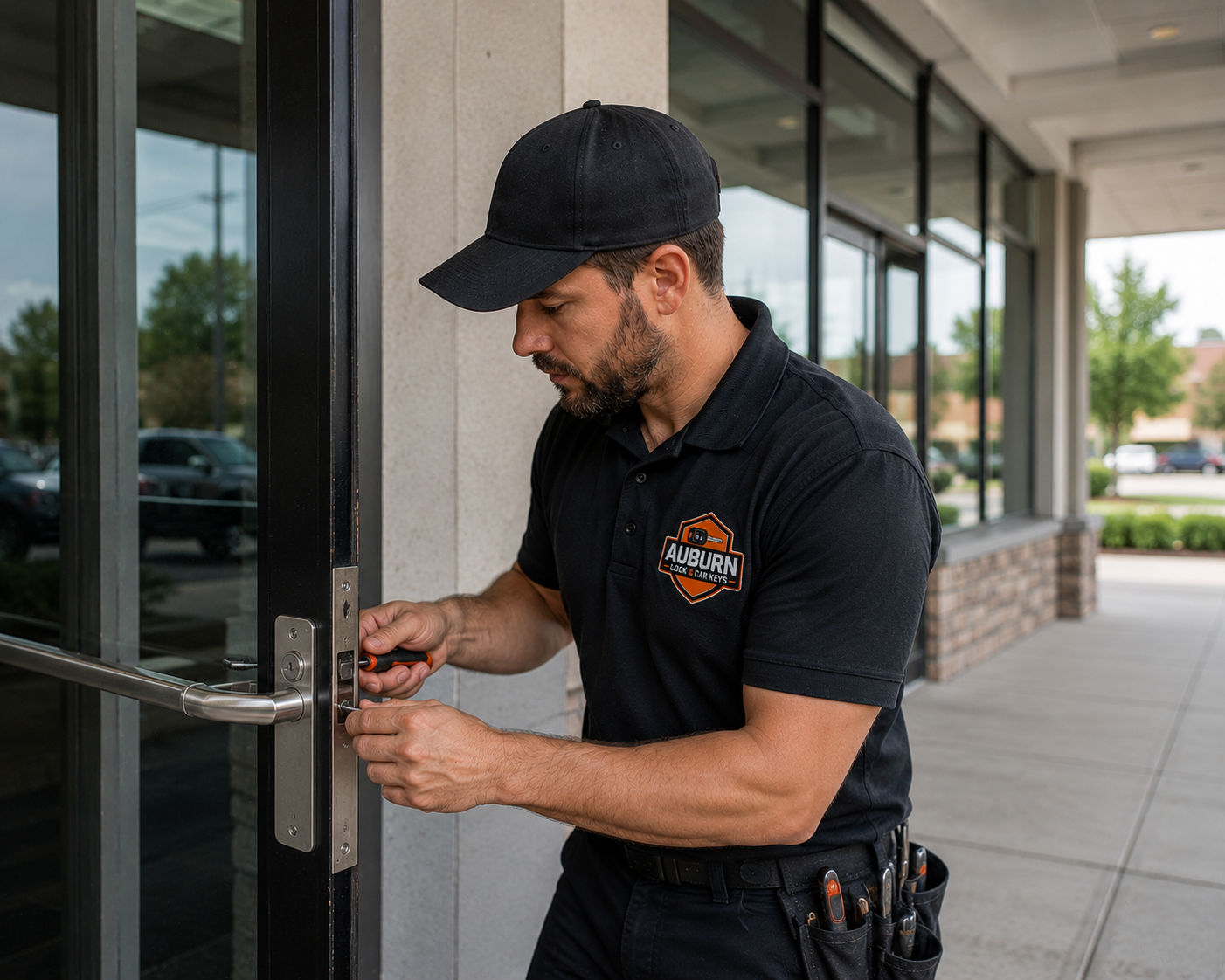
Auburn commercial locksmith installing a code-compliant panic bar on a business exit door
When You Need This Service

Common Reasons Auburn Businesses Call Us

Fire Inspection Findings

Inspector flagged your exit doors. We install code-compliant exit hardware that passes re-inspection.

New Build / Tenant Improvement

Opening a new restaurant, retail space, or office? Get exit hardware right from day one.

Occupancy Change

Converting a space (retail to restaurant, office to assembly) usually triggers new exit hardware requirements.

Hardware Past End-of-Life

Old crash bars that don't latch reliably are a code violation and security risk. Time to replace.

Our Process

How Panic Bar Installation Works

Panic bar installation involves door prep, exit device install, and trim install — typically 90-180 minutes per door.

01

Door Survey

We measure the door, identify mounting points, determine fire-rating requirements, and confirm code compliance for your occupancy.

02

Hardware Specification

Recommend specific device + trim combination meeting code, ADA, and your operational needs. Quoted before purchase.

03

Installation

Door prepped (drilling / mortising where needed), exit device mounted, trim installed on the opposite side, strike fitted to frame.

04

Test & Adjust

Door cycled, latch verified at all conditions, alignment fine-tuned. Ready for fire inspection.

Need a Locksmith Right Now?

Call us. We're on the road 24/7
across Auburn & South King County.

(253) 796-8550
FAQ

Panic Bar Installation Questions

Pricing depends on device type. Standard rim exit device installed: $485-$885 per door. Mortise exit device installed: $685-$1,285. Vertical-rod exit device installed: $785-$1,485. Fire-rated and electrified devices cost more. We provide flat-rate quotes after site survey.
Per the International Building Code, panic hardware is required on doors serving assembly occupancies with 50+ person capacity, educational occupancies, high-hazard occupancies, and certain other applications. Washington follows IBC with local amendments. Your fire marshal will identify which of your doors need panic hardware during inspection.
Technically you can install it, but you really shouldn't for commercial applications. Reasons: (1) Code compliance and ADA requirements require specific installation specs; (2) Fire-rated doors require certified installation to maintain their rating; (3) Insurance and liability — improper exit hardware that fails in an emergency is a serious legal exposure; (4) Most inspectors require professional installation documentation. Save the trouble — have it done right.
All fire exit devices are panic bars, but not all panic bars are fire-rated. Standard panic bars provide rapid egress. Fire-rated exit devices (carrying a UL label) additionally maintain the fire rating of fire-rated doors and assemblies. If your door is in a fire-rated wall (typical for stair enclosures, mechanical rooms, and certain corridor walls), you need fire-rated exit hardware. If just a regular exit, standard panic bar is fine.
Yes — alarmed exit devices are common for retail back-of-house doors where you want to allow emergency exit but discourage casual unauthorized use. Models like the Detex 10 Series include a 100dB alarm that sounds when the door is pushed open. Great for stockroom doors that shouldn't be regularly used as exits.
Yes — electrified exit devices integrate with most access control platforms. The exit side always works mechanically (free egress is non-negotiable for fire safety), while the entry side can be controlled by card, fob, PIN, or schedule. We design exit hardware to work with your existing or planned access control.